The Nepalese stock market has experienced significant growth in recent years. More young people are now investing their money in shares. One of the most popular ways to start investing is through IPOs.
Globally, too, IPOs continue to attract massive investor interest. The transaction value in the Initial Public Offerings market is projected to reach US$26.67 million in 2025, with the average transaction value standing at US$13.32 million. This shows how IPOs remain one of the most preferred entry points for new investors worldwide, including in Nepal.
If you’re new to investing, you’ve probably heard people talking about IPOs. Maybe your friends got lucky with an IPO allotment. Or perhaps you’ve seen news about companies raising millions through public offerings.
This guide will answer all your questions about IPO in Nepal. We’ll cover everything from the basics to advanced tips. By the end, you’ll know how to make smart IPO investment decisions.
What is an IPO in Nepal?
An IPO, or Initial Public Offering, is when a private company decides to sell its shares to regular people for the first time. Think of it like this: imagine your neighbor has a successful bakery business. If they want to expand and open more shops, they might need money from investors. Instead of taking a bank loan, they could offer parts of their business (called shares) to people like you and me. That’s basically what an IPO does.

In Nepal, companies from different sectors launch IPOs to raise funds. We’ve seen banks, hydropower companies, manufacturing firms, and trading companies all go public through this process. When you buy an IPO, you become a part-owner of that company, even if it’s just a tiny piece. These primary shares in Nepal represent your ownership stake in the company from day one.
Primary vs Secondary Market
When you apply for IPO shares, you’re investing in what’s called the primary market. This means you’re buying shares directly from the company at a fixed price. The company gets your money and uses it to grow their business.
The secondary market in Nepal is different. This is where people trade shares after the IPO is over. On the secondary market (like NEPSE), share prices go up and down based on what people are willing to pay. The company doesn’t get any money from secondary market trades – it’s just investors buying and selling among themselves.
What is the difference between IPO and FPO in Nepal?
Many new investors get confused between IPO and FPO. Both involve companies selling shares to the public, but they’re quite different.
An IPO is when a private company sells shares to the public for the first time. Whereas FPO means an already public company issues more shares.
| Factor | IPO | FPO |
| Timing | First time going public | After already being public |
| Company Status | Private to Public | Already Public |
| Market Presence | No previous trading | Already trading on NEPSE |
| Risk Level | Higher (unknown performance) | Lower (past performance visible) |
| Investor Knowledge | Limited company data | Full trading history available |
| Rights Issue | Not applicable | May include rights for existing shareholders |
5 Benefits of Investing in IPOs
While there are many advantages of IPO in Nepal, some of them are:
1. Safety and Regulation
IPOs in Nepal go through strict checking by SEBON (Securities Board of Nepal); they must match the IPO regulations. Before any company can launch an IPO, it must prove they have good financial health and clear business plans. This means you’re not investing in just any company – only those that meet high standards can offer shares to the public.
SEBON IPO guidelines ensure companies provide all the important information about their business, finances, and future plans. This transparency helps you make informed decisions about where to put your money.
2. Potential for Higher Returns
Many IPOs in Nepal have given investors excellent returns over the years. When you buy shares at the IPO price and the company performs well, your investment can grow significantly once the shares start trading on the secondary market.
Some of the best IPO performances till now in Nepal’s market started as IPOs. Early investors in these companies saw their money multiply as the businesses grew and became more profitable. Looking at IPO history in Nepal, we can see that patient investors who chose quality companies often achieved impressive returns.
3. Early Entry into Growing Companies
When you invest in an IPO, you’re getting in at the ground floor. You become a part-owner before the general public can buy and sell the shares freely. This early entry often means you get shares at a fair price, before market emotions and speculation can drive prices higher.
Many successful investors in Nepal built their wealth by identifying premium IPO opportunities during their launch stage and holding onto those investments as the companies grew. These successful IPO examples show the importance of getting in early with quality companies.
4. Portfolio Diversification
IPOs give you access to companies from different industries. In recent years, we’ve seen IPOs from banks, hydropower companies, insurance firms, and manufacturing businesses. This variety helps you spread your investment risk across different sectors.
Instead of putting all your money in one type of business, you can use IPOs to build a balanced portfolio that includes various industries.
5. Lower Entry Costs
Unlike some investment options that require large amounts of money, most IPOs in Nepal allow you to invest relatively small amounts. This makes it possible for students, young professionals, and middle-class families to start their share investment journey without needing huge savings.
Criteria to Issue IPO in Nepal
Not every company can just decide to launch an IPO tomorrow. SEBON IPO guidelines have set clear rules that companies must follow before they can offer shares to the public. Understanding these criteria to issue IPO helps you know why IPO companies are generally considered safer investments.
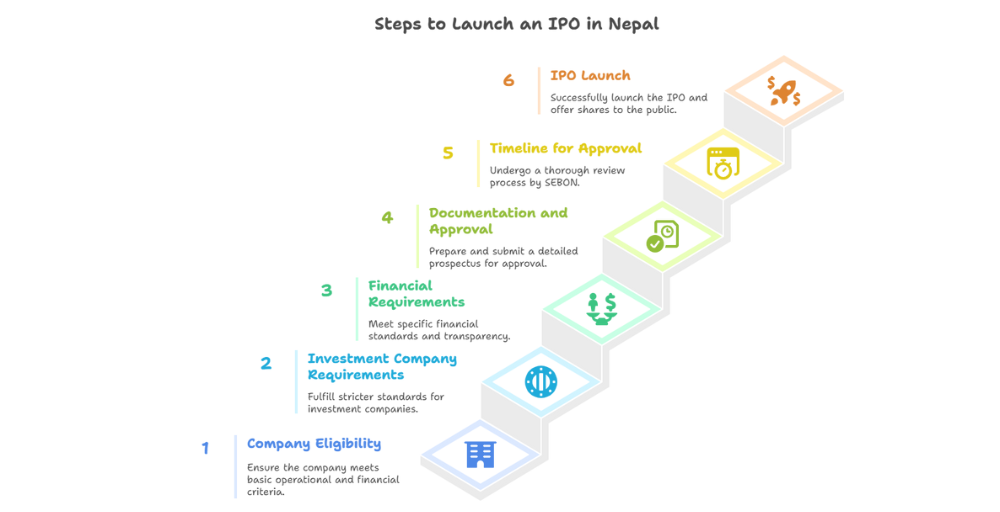
General Company Eligibility Requirements
To issue an IPO in Nepal, a company must have been operating for at least three years. This means they have a track record you can look at. The company must also show that it has been profitable or has strong potential for future profits.
Companies need to have proper management systems, clear business plans, and good corporate governance practices. They can’t have any major legal issues or disputes that might affect their business. The company should also have a minimum of seven shareholders and maintain a minimum paid-up capital of NPR 1 crore.
Recent Changes in Investment Company Requirements
SEBON has recently introduced stricter standards for investment companies seeking IPOs. As of June 2025, investment companies now face more demanding requirements including:
- Minimum paid-up capital of Rs. 50 crore (significantly higher than the general requirement)
- Operational track record of at least three years with profits recorded in the last two consecutive fiscal years
- Sector-specific investment requirements in productive sectors like energy, agriculture, communications, tourism, and manufacturing
- Mandatory credit rating of at least one level above baseline
These changes show how SEBON and CDSC are working together to ensure only financially strong companies can access public funds through IPOs.
Financial Requirements
SEBON requires companies to meet specific financial standards. The company must have audited financial statements for the past few years. These statements need to show that the business is financially healthy and capable of using investor money wisely.
The company must also clearly explain how they plan to use the money they raise from the IPO. Whether it’s for expanding operations, paying off debt, or funding new projects, everything must be transparent.
Documentation and Approval Process
Companies must prepare a detailed prospectus – a document that tells investors everything about the business. This includes their history, financial performance, management team, business risks, and future plans.
The prospectus goes through multiple reviews by SEBON officials, legal experts, and financial analysts. Only after thorough checking does SEBON give approval for the IPO launch.
Timeline for Approval
The entire IPO timeline from application to IPO launch usually takes several months. SEBON takes time to verify all information and ensure everything meets their standards. This careful review process is one reason why IPO investments are considered relatively safe compared to other investment options.
Companies also need to work with registered merchant bankers and underwriters who help them through the process and ensure all regulations are followed properly.
5 Things to Consider Before Applying for an IPO
While IPOs can be great investment opportunities, you shouldn’t jump into them without doing your homework. Here are the key things every investor in Nepal should think about before putting money into any IPO.
1. Company Financial Health Analysis
Before investing, take time to read the company’s prospectus carefully. Look at their profit and loss statements from the past few years. Is the company making money consistently? Are their revenues growing? Are they drowning in debt?
Pay attention to how the company plans to use the IPO money. Companies that want to expand their business or invest in new technology are often better choices than those just trying to pay off old debts.
Don’t worry if financial statements look complicated at first. Focus on simple things: Is the company making more money than it spends? Are their profits growing each year? These basic questions can tell you a lot.
2. Market Conditions Evaluation
The timing of your investment matters. If the overall stock market in Nepal is doing well, new IPO shares might perform better after listing. But if the market is down, even good companies might see their share prices drop initially.
Look at how recent IPOs have performed. If most new companies are seeing their share prices fall after listing, it might be better to wait for better market conditions.
Also consider what’s happening in the economy. During uncertain times, it’s often safer to be more careful with your investments.
3. Risk Tolerance Assessment
Be honest about how much risk you can handle. Can you afford to lose the money you’re investing? If losing this investment would seriously hurt your finances, you might want to invest a smaller amount or wait until you’re in a better financial position.
Remember that all investments carry risk, including IPOs. Even companies that look great on paper can face unexpected problems after going public.
4. Investment Timeline Planning
Think about when you might need this money. IPO investments work best when you can hold onto the shares for several years. If you might need the money within a few months, IPO investing might not be right for you.
Some investors make the mistake of expecting quick profits from IPOs. While some do well immediately, others take time to show their true value. Having a long-term mindset usually leads to better results.
5. Research and Due Diligence Tips
Don’t just rely on what friends or family tell you about an IPO. Do your own research. Read news articles about the company and its industry. Talk to people who understand the business sector the company operates in.
Check if the company has experienced management with a good track record. Look at who their competitors are and how they stack up against them. The more you know, the better decisions you can make.
How to Choose the Best IPOs?
With so many IPOs launching in Nepal, picking the best IPOs can feel overwhelming. Here’s a simple approach to help you identify IPOs that might be worth your investment.
Reading IPO Prospectus Effectively
Start with the company overview to understand what business they’re in and how they make money. Then look at the “use of proceeds” section to see how they plan to spend the IPO money. Companies with clear, growth-focused plans are usually better choices.
Check the financial summary section for basic numbers like revenue, profit, and debt levels over the past few years. You don’t need to be a financial expert – just look for positive trends like growing sales and profits.
Analyzing Company Fundamentals
Ask yourself some simple questions: Does this company solve a real problem or meet a genuine need? Is there demand for their products or services? Do they have advantages over their competitors?
Look at the management team’s background. Have they successfully run businesses before? Do they have experience in this industry? Good management often makes the difference between success and failure.
Understanding Valuation Methods
While you don’t need to become a valuation expert, understanding basic concepts helps. Compare the IPO price to the company’s earnings and revenue. If the price seems very high compared to what the company actually makes, it might be overvalued.
Look at how similar companies are valued in the secondary market. If the IPO company is asking for much higher prices than established competitors, ask yourself why.
Comparing with Industry Peers
Research other companies in the same industry. How does this IPO company compare in terms of size, profitability, and growth prospects? Sometimes a smaller company with better growth potential can be a better investment than a large, established player.
Successful IPO Examples from Nepal
Some of the most successful IPOs in Nepal’s history include major banks and hydropower companies that went public during favorable market conditions. These companies had strong fundamentals, experienced management, and clear growth strategies.
The best-performing IPOs typically came from companies that used their IPO money effectively to expand operations and increase profits. Many investors who held onto shares from these successful IPOs saw significant returns over several years.
Future of IPO in Nepal
The IPO landscape in Nepal is changing rapidly, and understanding these trends can help you make better investment decisions in the coming years.
Upcoming IPO Trends and Opportunities
More companies from diverse sectors are planning to go public in Nepal. We’re seeing increased interest from technology companies, renewable energy firms, and service-based businesses. This diversification means more investment options for people like you.
The government is also encouraging more companies to list on the stock exchange through various incentives. With these supportive policies, the number of upcoming IPOs in Nepal is expected to rise, giving investors access to quality companies with strong growth potential.
Government Policy Improvements
SEBON continues to refine its regulations to make the IPO process more efficient while maintaining investor protection. Recent policy changes have made it easier for companies to go public while ensuring they still meet high standards.
The government is working on digital infrastructure improvements that will make IPO applications and share trading more convenient for investors. These technological upgrades should make the entire process smoother and more accessible.
New policies are also being developed to encourage long-term investing rather than short-term speculation. These changes aim to create a more stable and mature capital market in Nepal.
Market Expansion Predictions
Nepal’s capital market is still relatively small compared to other countries, which means there’s significant room for growth. As more companies go public and more people start investing, the market is likely to become more mature and stable.
The growing middle class in Nepal represents a large pool of potential investors. As financial literacy improves and investment options become more accessible, we can expect increased participation in IPOs and stock market investing.
Investment Landscape Evolution
The future will likely bring more sophisticated investment products and services. This could include mutual funds that focus on IPO investments, research services that help analyze new offerings, and better investor education programs.
Professional investment advisory services are becoming more common, which should help individual investors make better decisions about which IPOs to invest in and when.
Frequently Asked Questions (FAQs)
Why do companies go public?
Companies go public to raise money for growth, build their brand, let early investors sell their shares, and reward employees with stock options.
What are the different types of IPO investors?
The different types of IPO investors are Retail Investors, Institutional Investors, and Non-Institutional Investors (NIIs).
What is the difference between IPO and NFO?
An IPO (Initial Public Offering) is when a company sells its own shares to the public for the first time. Whereas an NFO (New Fund Offer) is when a mutual fund company launches a new investment scheme and asks people to invest in it.